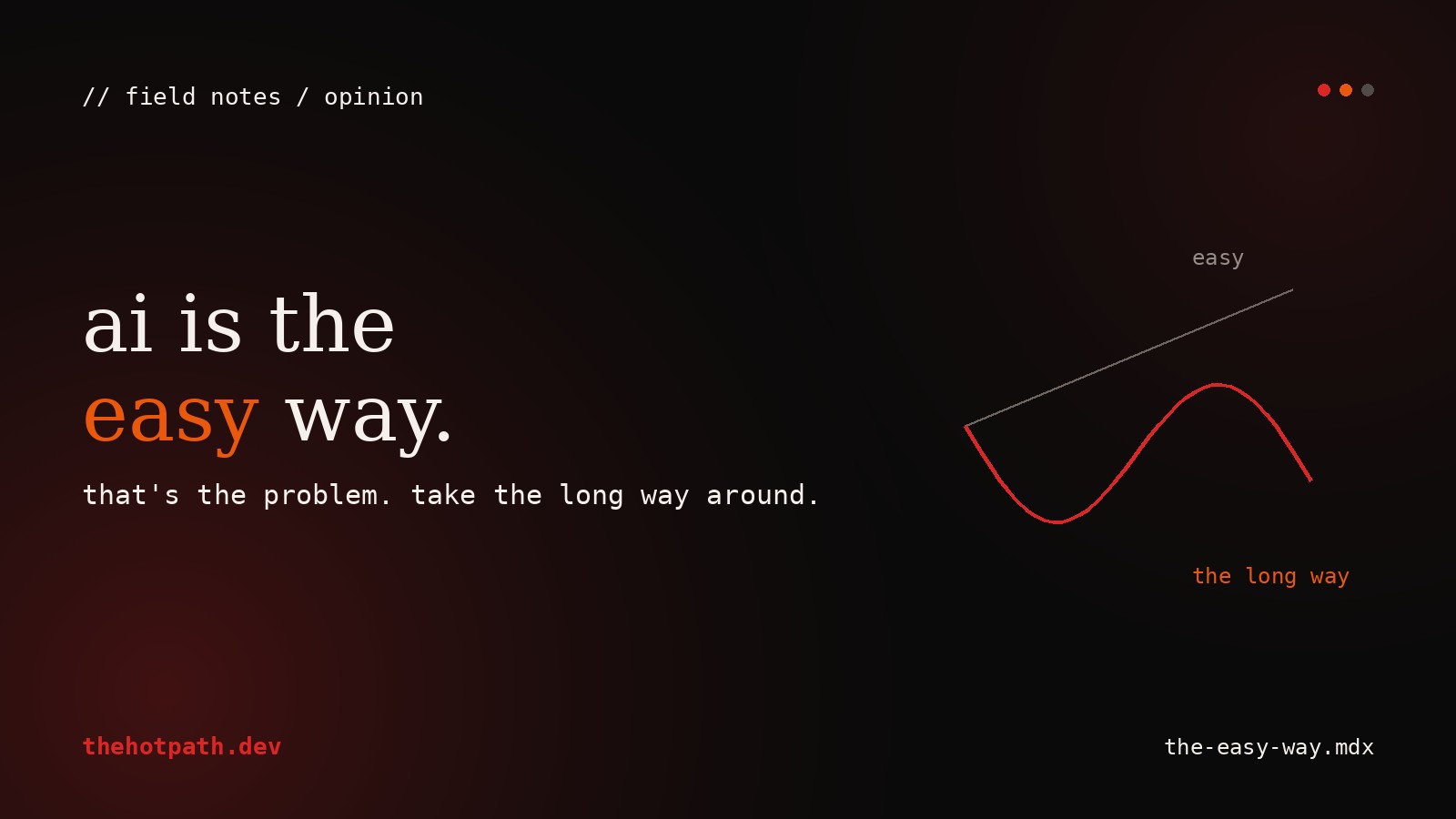
ai is the easy way now, and that is precisely what makes it dangerous.
ask for a website, get a website. ask for a caption, get a caption. ask for a strategy, an essay, a plan, a name, get all of it, instantly, in a tone that sounds confident and finished. the speed is real. i use it every day. but the speed is also a trap, and i think most people are walking straight into it with a smile.
// this is the unpopular one. say it anyway.
passable is the trap
the danger of the easy way is not that ai gives you bad answers. it's that it gives you passable ones. bad is useful; bad gets rejected and you keep working. passable gets shipped. passable feels like done. and a world full of passable is a world where everything is fine and nothing is good, because the model's default output is, by construction, the average of everything it has seen, and the average is forgettable by definition.
instant gratification trains a specific muscle: accept the first thing. it atrophies the muscle that actually matters, which is the one that looks at the first thing and says no, not that, again. the easy way is easy because it skips the part where taste happens.
what the slow way buys you
i take the long way around on purpose, and not out of nostalgia for struggle. the slow way buys three things the fast way can't.
it buys judgment. when you sit with a problem instead of accepting the first generation, you develop a point of view about it, and a point of view is the only thing that can't be generated on demand.
it buys systems that hold up. the fast answer is a single output. a thorough build is a system, with constraints and refusals and a logic you can defend later. one breaks the moment conditions change. the other was designed for the conditions changing.
it buys the human part. the connection, the care, the specific weird choices that make a thing feel made by someone. that's the part the computer doesn't have, and it's the only part anyone remembers.
i'm not anti-ai. i'm anti-passable.
let me be exact, because this gets misread. i am not telling you to abandon the tools. i direct ai agents to build real product; the site you're reading this on was built that way. the argument is not speed versus craft. the argument is who keeps the judgment.
use the easy way for the easy parts. the boilerplate, the scaffold, the first draft, the thing that genuinely doesn't need you. then refuse its first answer on the part that does. that refusal is the whole job now. anyone can generate. the value moved to the person willing to look at the generation and say, not good enough, the long way around, again.
// the easy way is a tool. the hard way is a choice. keep making the choice.